
Table Games
How to Play Blackjack
In blackjack you try to finish with a hand closer to 21 than the dealer's without going over. Unlike baccarat or roulette, your decisions affect the result, which is why basic strategy can reduce — but never remove — the house edge.
Card values
| Cards | Value |
|---|---|
| 2 to 10 | Face value |
| Jack, Queen, King | 10 |
| Ace | 1 or 11, whichever helps the hand |
A hand with an ace counted as 11 is a soft hand (for example, ace + 6 is soft 17). A hand with no ace, or an ace that must count as 1, is hard.
How a round works
- Place your bet.
- You and the dealer each receive two cards. One dealer card is visible (the upcard).
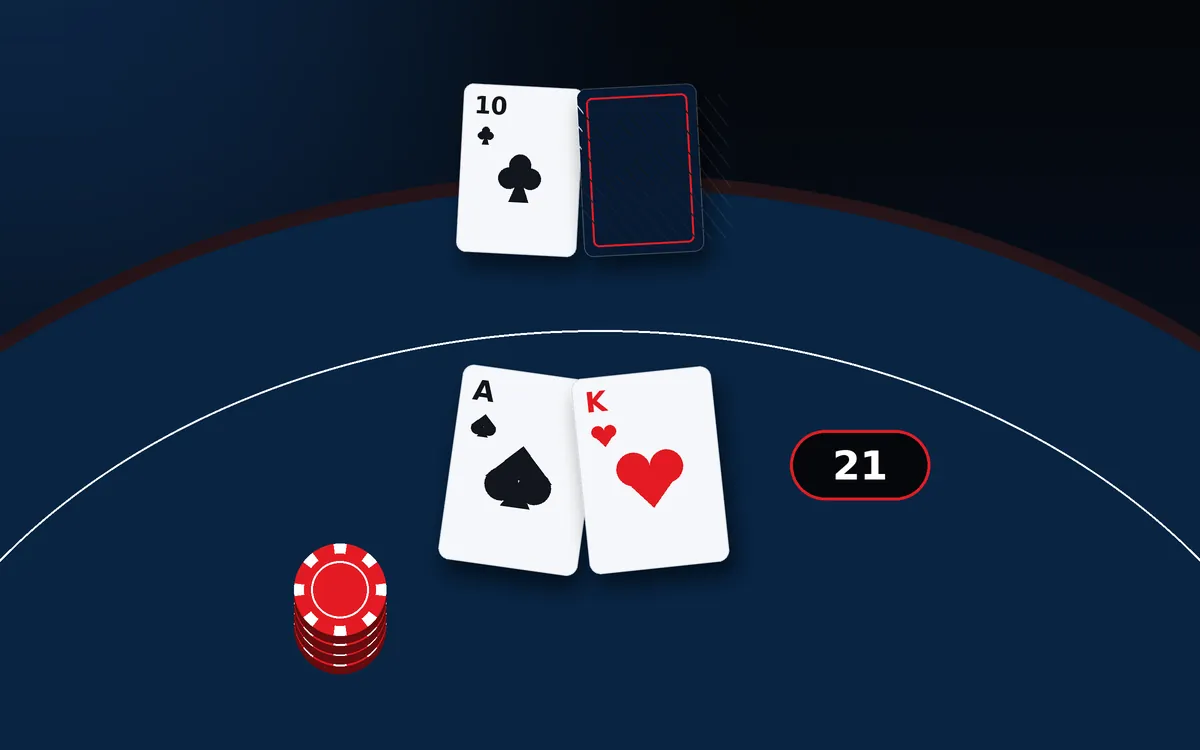
- An ace and a ten-value card as your first two cards is a blackjack (a natural).
- You choose your actions until you stand or go over 21 ("bust").
- The dealer reveals their second card and draws according to fixed rules.
- The hand closer to 21 wins. Equal totals are a push, and your stake is returned.
Your options
| Option | What it means |
|---|---|
| Hit | Take another card. |
| Stand | Keep your current total. |
| Double down | Double your bet, receive exactly one more card, then stand. |
| Split | Split a pair into two hands, adding a second bet of equal size. |
| Surrender | Where offered, give up the hand and get half the bet back. |
| Insurance | A side bet offered when the dealer shows an ace, paying 2:1 if the dealer has blackjack. |
Dealer rules
The dealer has no choices. Most tables require the dealer to draw until reaching at least 17. Tables state whether the dealer stands on soft 17 (S17) or hits it (H17); standing on soft 17 is slightly better for the player.
Payouts
| Result | Typical payout |
|---|---|
| Win | 1:1 |
| Blackjack | 3:2 (some tables pay 6:5) |
| Insurance | 2:1 |
| Push | Stake returned |
A 6:5 blackjack payout increases the house edge noticeably. Check the table before you sit down.
Basic strategy
Basic strategy is the mathematically best decision for every combination of your hand and the dealer's upcard, calculated for a given set of rules. Followed consistently, it reduces the house edge to a small figure — often cited at around 0.5% under common rules. It does not remove the edge and does not guarantee a winning session.
A few widely known principles:
- Always split aces and 8s.
- Never split 10s or 5s.
- Stand on hard 17 or more.
- Decline insurance.
The full strategy depends on the exact table rules, such as the number of decks and whether the dealer hits soft 17.